
“AI will not replace digital marketing; it will reshape it in ways we’re already feeling. It takes over the heavy, repetitive work, but it cannot replace human creativity, judgment, and emotional understanding. The real shift is not losing marketers, but redefining their role. Those who adapt and work with AI won’t just survive; they’ll lead the future.”
A few years ago, “AI in marketing” sounded like a tech conference buzzword. Today, it’s the question every brand manager, content strategist, SEO specialist, and CMO is asking in earnest:
Will AI replace digital marketing, or is it here to transform it?
The honest answer isn’t a comforting yes or no. It’s both. And neither. And something entirely more interesting. AI is already writing blog drafts, managing ad bids, generating email sequences, and analyzing customer behavior at a scale no human team ever could. But the companies racing to replace their marketing teams with automation are quietly discovering the same thing: AI without strategic direction is just noise at scale.
This blog takes a clear-eyed look at what’s actually changing in digital marketing because of AI, which roles are at risk, which are gaining power, and what marketers need to do right now to stay relevant, valuable, and indispensable in an AI-driven landscape.
What Does “Replace” Actually Mean in the Context of AI?
Before we spiral into fear or optimism, let’s define the word “replace.”
When people ask, “Will AI replace digital marketing?” they usually mean one of two things:
- Will AI make human marketers obsolete?
- Will AI fundamentally change how marketing is done?
The answer to the first question is: largely, no, at least not the way most people fear. The answer to the second: absolutely, yes, and it already has.
AI in digital marketing is not arriving like a wrecking ball. It’s arriving like electricity once did: quietly embedding itself into every process, tool, and workflow until operating without it feels unthinkable. The marketers who will struggle are not those who compete with AI. They’re the ones who refuse to adapt to working with it.
How AI Is Already Transforming Digital Marketing (Right Now)
An AI-powered marketing strategy is no longer futuristic. It’s embedded in the tools most teams already use daily. Here’s how the transformation is unfolding across key marketing disciplines:
1. Content Marketing and SEO
Generative AI marketing tools like ChatGPT, Gemini, and Jasper can produce blog outlines, product descriptions, meta tags, and even full-length articles in seconds. On the SEO side, machine learning algorithms now power everything from Google’s search rankings to keyword intent clustering and semantic search analysis.
What AI handles well:
- First drafts and content variations
- Keyword research and clustering
- On-page SEO audits
- SERP analysis
What still requires humans:
- Deciding what content to create and why
- Matching content to brand voice and audience psychology
- Editorial judgment, knowing what’s good, what’s misleading, and what damages trust
- Strategic content planning tied to business goals
The shift here is significant. Artificial intelligence and content marketing are now inseparable, but the human editor, strategist, and brand voice owner remain irreplaceable.
2. Paid Advertising and Media Buying
Marketing automation tools in the paid media space have advanced dramatically. Google’s Performance Max, Meta’s Advantage+, and programmatic platforms now handle bidding, audience targeting, creative testing, and budget allocation with minimal human input.
AI is simply better than humans at:
- Processing real-time auction data
- Optimizing bids at millisecond speed
- Running thousands of A/B creative variations simultaneously
But here’s the catch: AI optimizes for the metrics it’s given. Set the wrong goal, and AI will chase it perfectly, right off a cliff.
Human marketers are still needed to:
- Define the right KPIs that actually connect to business outcomes
- Evaluate whether “winning” on-platform metrics translates to real revenue
- Identify when a campaign is technically succeeding but damaging brand perception
- Align paid strategy with broader GTM motions
3. Email Marketing and Marketing Automation
Email is where marketing automation tools have been dominant for years, but AI has taken it further. Tools now generate subject lines that outperform human-written ones, personalize email sequences based on behavioral triggers, and predict send-time optimization at an individual level.
Yet the brands seeing the best email performance are those combining AI’s personalization engine with a human-led strategy. They’re asking: What story are we telling over this sequence? Does this automation reflect our brand values? Are we building a relationship or just triggering workflows?
4. Customer Experience and Personalization
Machine learning for marketers has unlocked what was previously impossible: true 1:1 personalization at scale. AI can analyze browsing behavior, purchase history, content engagement, and even predict lifetime value to serve the right message, at the right moment, on the right channel.
This is a genuine superpower, but it requires human oversight to ensure it doesn’t tip into invasive, off-brand, or ethically questionable territory.
5. Analytics and Data Interpretation
Traditional analytics required marketers to pull reports, build dashboards, and manually identify trends. AI now does much of that automatically, surfacing anomalies, predicting trends, and generating natural-language summaries of complex data sets.
But data insights without context are dangerous. A metric can be technically accurate and strategically misleading. Knowing when to trust the data, when to challenge it, and how to translate it into a decision a CFO will fund that’s still deeply human work.
The Real Threat: Task Displacement, Not Job Elimination
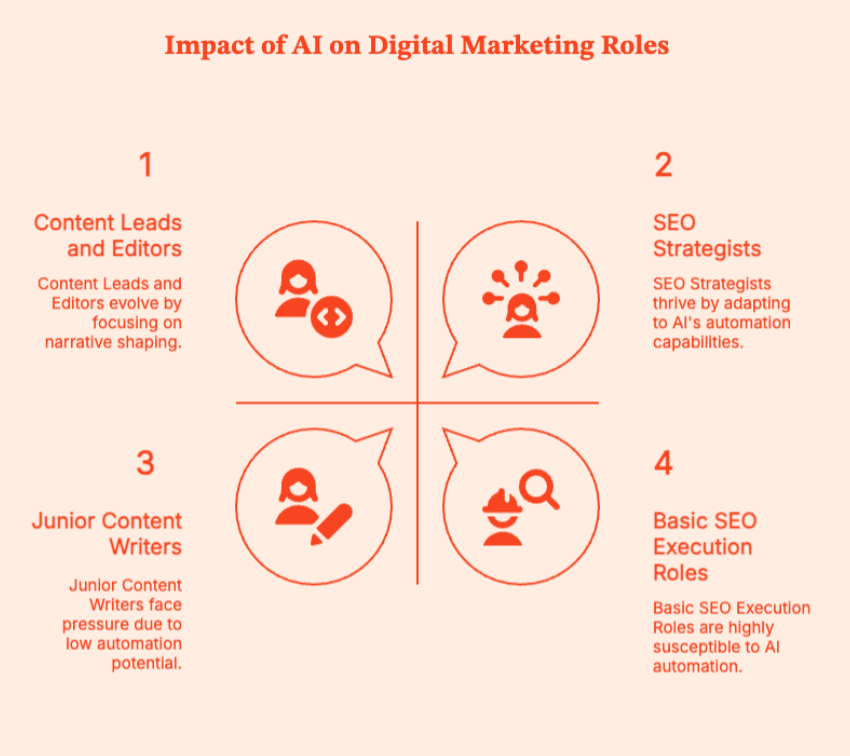
The most important nuance in the conversation about the future of digital marketing jobs is this: AI replaces tasks, not roles.
Any role built primarily around repetitive, high-volume execution is being compressed. But roles built around judgment, strategy, creativity, and accountability are expanding.
Roles Under the Most Pressure
| Role | What AI Is Taking Over | What Still Requires Humans |
| Junior Content Writer | First drafts, volume content | Editorial judgment, brand voice |
| Basic SEO Specialist | Keyword research, on-page audits | Strategic content mapping, authority building |
| Media Buyer (tactical) | Bid management, targeting | Strategic content mapping, authority building |
| Data Analyst (reporting) | Dashboard creation, trend summaries | Contextual interpretation, stakeholder communication |
Roles That Are Growing in Value
- SEO Strategists who connect content to user intent and business outcomes
- Performance Marketers who design experiments and interpret signals
- Content Directors and Editors who maintain narrative consistency and brand standards
- Marketing Ops and RevOps leaders who architect the data and automation systems
- AI Marketing Managers, an entirely new role managing, auditing, and optimizing AI workflows
- Demand Generation Leaders who tie marketing activity to pipeline and revenue
The digital marketing transformation isn’t eliminating the need for marketers. It’s eliminating the need for marketers who only execute.
What AI Cannot Do (No Matter How Advanced It Gets)
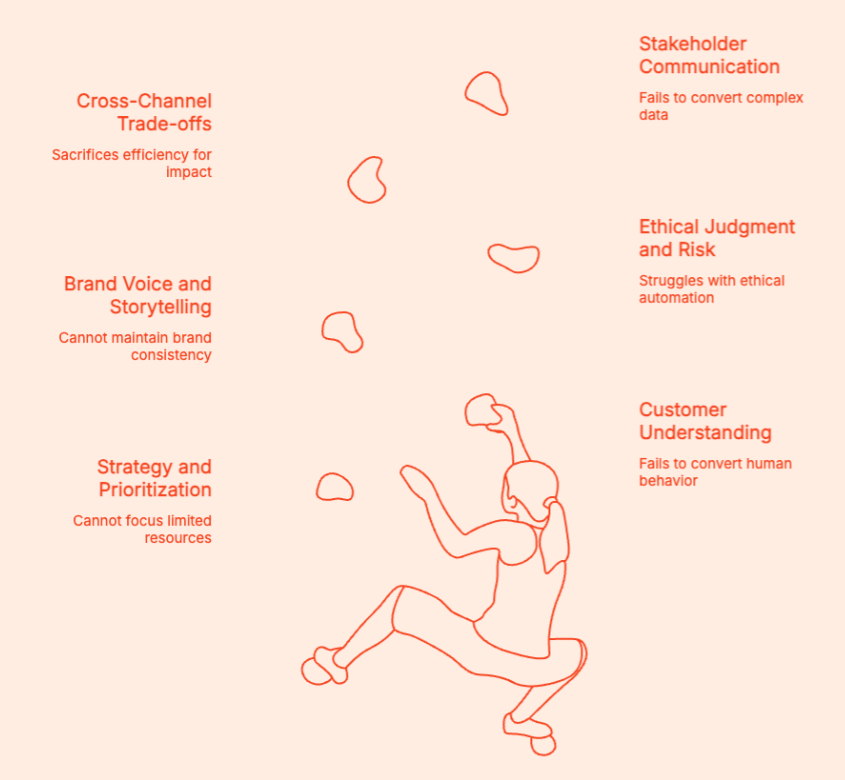
Let’s be specific. Here are the things that remain genuinely, durably human in AI in digital marketing:
Strategic Judgment Under Uncertainty
AI is trained on historical data. It’s excellent at pattern recognition within known parameters. But marketing frequently requires decisions in ambiguous, novel situations: entering a new market, responding to a reputational crisis, or pivoting an entire campaign strategy mid-quarter. These decisions involve intuition, context, experience, and risk tolerance that no model has mastered.
Brand Voice and Emotional Truth
AI can replicate a brand voice if given enough examples. It cannot feel when something is off. The difference between content that converts and content that alienates is often a tone, a word choice, a cultural reference, subtle things that a skilled editor catches instantly, and an AI confidently gets wrong.
Ethical and Cultural Judgment
Human vs AI marketing diverges most sharply here. AI doesn’t know when an automated campaign is tone-deaf in the context of a news cycle. It doesn’t understand regional sensitivity, community norms, or the reputational cost of moving too fast. Marketers carry an ethical responsibility that cannot be delegated to a model.
Cross-Functional Leadership and Stakeholder Communication
Marketing decisions rarely exist in isolation. They require negotiation with the product, alignment with sales, and buy-in from finance. Translating campaign data into a strategic recommendation that leadership trusts and funds is a human skill rooted in relationships, credibility, and communication.
Accountability
This is the big one. “The AI decided” will never be an acceptable answer to a board, a regulator, or an angry customer. Every AI-driven outcome needs a human who owns it. That responsibility shapes strategy in ways that fundamentally require human judgment.
How Marketers Can Stay Relevant in an AI-Transformed Industry
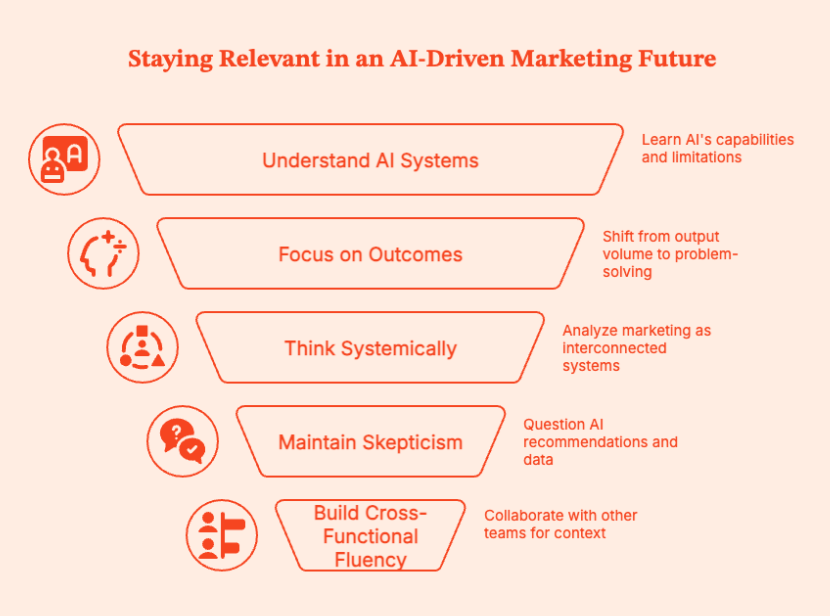
MarTech is evolving faster than most marketers can track. The question isn’t whether to engage with AI, it’s how to engage strategically. Here’s the roadmap:
1. Shift from Outputs to Outcomes
Stop measuring your value by how much content you produce or how many campaigns you launch. Start measuring it by the business outcomes you drive. AI can generate volume. It cannot own results.
Ask yourself: Am I the person who decides what success looks like? Am I accountable for whether this moves the business forward? If yes, AI makes you more powerful. If not, AI may replace you.
2. Understand AI, Don’t Just Use It
There’s a meaningful difference between prompting an AI tool and understanding how it works, what data it was trained on, where it hallucinates, and what it gets systematically wrong. Marketers who develop machine learning for marketers’ literacy will consistently outperform those who treat AI as a black box.
3. Think in Systems, Not Channels
AI-powered marketing strategy at its best isn’t optimizing one channel; it’s designing the system that connects acquisition, activation, retention, and revenue. Understanding how all the pieces interact is what separates strategic marketers from tactical ones.
4. Maintain Healthy Skepticism
AI outputs are confident even when wrong. The skill of questioning a recommendation that looks right but isn’t answering the real question is increasingly valuable. Train yourself to ask: Is this technically accurate? Is it contextually appropriate? Does it serve the actual business goal?
5. Develop Cross-Functional Fluency
The most AI-resistant marketers are those who work fluidly across functions, talking revenue forecasting with sales, discussing trade-offs with product, and designing pipelines with ops. Generative AI marketing accelerates execution, but cross-functional judgment determines direction.
6. Build Your Judgment Publicly
Publish your thinking. Share your frameworks. Build a point of view on your industry. AI cannot build a reputation for insight; you can. The marketers who will thrive are those who are known for their judgment, not just their output.
What Marketing Leaders Must Get Right About AI
If you manage a marketing team, the decisions you make in the next 12-24 months will define your team’s culture, capability, and competitive position for years. Here’s what the best leaders are getting right:
Don’t Treat AI as a Headcount Reduction Strategy
Cutting your team and replacing them with AI to “do more with less” is a short-term gamble with long-term costs. You’ll ship more volume with less quality, automate processes no one fully understands, and lose the institutional knowledge that makes your brand coherent.
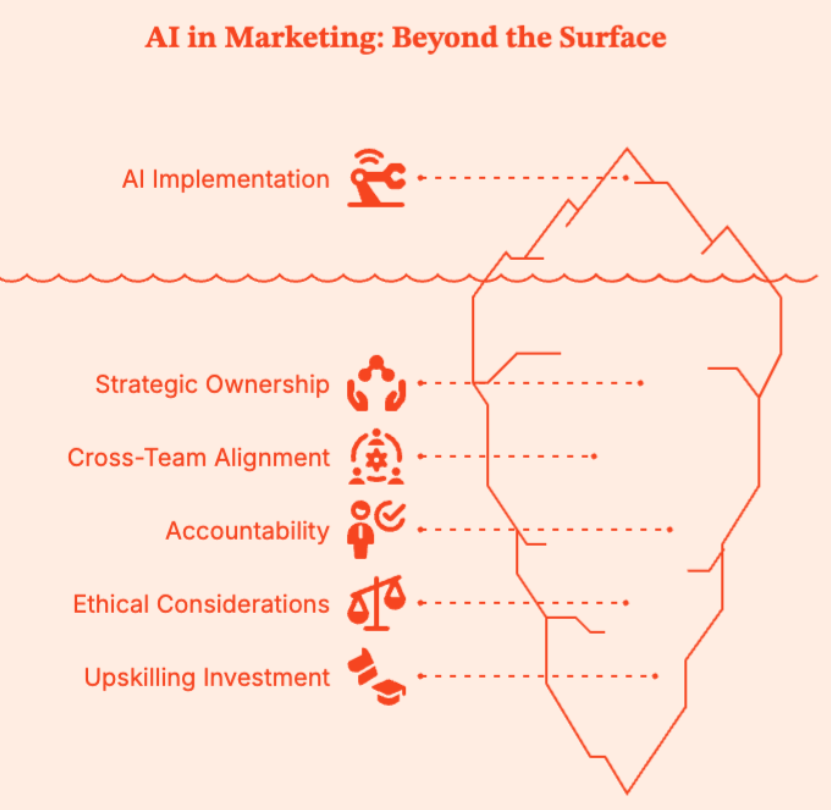
Invest in AI Literacy as a Team Capability
Make MarTech fluency part of your team’s professional development. Not just using AI tools, but also understanding how to evaluate their outputs, question their recommendations, and integrate them responsibly into strategic workflows.
Assign Human Owners to Every AI Workflow
Every automated process in your marketing operation should have a named human owner who is accountable for its performance and its ethical guardrails. “The algorithm did it” is not a risk management strategy.
Redefine Roles Around Judgment, Not Tasks
The job descriptions that made sense three years ago may not reflect what you actually need now. Consider redesigning roles around systems thinking, strategic ownership, and AI oversight, not just campaign execution.
The Bigger Picture: A Historical Perspective
Every generation of marketers has faced a technology that threatened to make them obsolete. Spreadsheets didn’t eliminate finance teams; they made financial analysts more powerful. Marketing automation didn’t kill email marketers; it made good ones more effective and exposed weak ones faster. Google Analytics didn’t replace analysts; it raised the floor for what analytical rigor looked like.
AI in digital marketing follows the same pattern. It removes the friction around execution. It raises the baseline. It exposes those who were coasting on volume and rewards those who were always bringing genuine strategic value.
The digital marketing transformation underway is not a threat to the profession. It’s a clarification of what the profession was always supposed to be: strategic, accountable, creative, and deeply connected to business outcomes.
Final Thoughts
So, will AI replace digital marketing, or transform it? Transform it. Definitely, completely, and in ways we’re still only beginning to understand.
But here’s the truth that gets lost in the noise: AI is a tool, not a strategist. It is extraordinarily good at execution, pattern recognition, personalization at scale, and data processing. It is not good at deciding what to do, why it matters, or whether it’s the right thing for the business and the customer.
The marketers who thrive in an AI-transformed industry are not the ones who learn to write better prompts. They’re the ones who bring irreplaceable human judgment about brand, about customers, about strategy, about ethics, and who use AI to amplify their impact rather than replace their thinking.
The future of digital marketing is not human versus AI. It’s human and AI with humans firmly in charge of what matters most: the decisions that build brands, earn trust, and drive real business growth. That’s not a threat to the profession. That’s an upgrade.
FAQs
Will AI completely replace digital marketers?
No. AI will automate specific tasks within digital marketing, content drafting, bid management, data reporting, and keyword research, but it cannot replace the strategic judgment, creativity, ethical oversight, and accountability that human marketers bring. The profession is transforming, not disappearing.
Which digital marketing jobs are most at risk from AI?
Roles built primarily around high-volume, repetitive execution are most vulnerable. This includes junior content writers focused on output volume, basic SEO executors, manual media buyers, and analysts whose job ends at pulling reports. Roles that involve strategy, systems thinking, and cross-functional leadership are gaining value.
Is AI better at digital marketing than humans?
AI is better at specific tasks: processing large data sets, running thousands of creative variations, optimizing bids in real time, and personalizing at scale. Humans are better at the things that actually determine marketing strategy: deciding what to optimize for, understanding brand context, managing stakeholder relationships, and owning outcomes.
How is generative AI changing content marketing?
Generative AI can produce first drafts, variations, outlines, and even full articles quickly. This is changing the role of content marketers from production-focused to strategy and editorial-focused. The most effective content teams now use AI to accelerate creation while humans ensure quality, brand alignment, and strategic relevance.
What skills should digital marketers develop to stay relevant?
Focus on: strategic and systems thinking, AI literacy (understanding how tools work, not just how to use them), data interpretation and contextual analysis, cross-functional communication, and editorial judgment. The ability to evaluate and critically apply AI outputs is now one of the most valuable skills in marketing.
What does the future of digital marketing look like with AI?
The future is AI-augmented marketing: humans making high-quality strategic decisions faster, with better data, and at greater scale than was previously possible. Marketing will become more technical, more outcome-driven, and more accountable. Entirely new roles, AI marketing managers, prompt strategists, and ethics oversight leads are already emerging. The field is not shrinking. It’s evolving.